

Sure, you can sell your home for sale by owner in Virginia Beach, Chesapeake, Norfolk, or Suffolk. Here’s the honest truth nobody selling you something else wants to say out loud: if you’re willing to do everything a good REALTOR® actually does — not just the parts that sound easy — you can genuinely save real money doing it yourself. If you’re not willing to do all of it, you’ll probably just end up underpricing your home and selling it anyway, without ever finding out what you left on the table.
Either way, there’s something real at the end of it. You’ll cross the finish line. You’ll have sold your own house, handled your own negotiations, and gotten through the whole process on your own terms. That’s genuinely rewarding, headaches and all. What you won’t ever get is a clear answer to the one question that lingers afterward: what could you have gotten with the right person handling it for you?
I’m not writing this to talk you out of selling for sale by owner in Virginia Beach or anywhere else in Hampton Roads. I’m writing it so you know exactly what the job actually involves before you decide whether you’re up for all of it.
One thing upfront: I’m a REALTOR®, not an attorney. Several parts of this — disclosures, contracts, contingencies — touch on real legal requirements, and this isn’t legal advice. Talk to a real estate attorney for anything specific to your situation. What I can walk you through is what the process actually looks like and where FSBO sellers most often get tripped up.
The Real Numbers on Selling By Owner
According to National Association of Realtors data, FSBO homes sold at a median price of $380,000 in 2024, compared to $435,000 for agent-assisted sales — a real gap, not a rounding error. Other industry analysis puts the FSBO discount at around 18%, or roughly $80,000 less on a home at the median Virginia listing price.
That gap isn’t destiny, whether you’re in Virginia Beach, Norfolk, Chesapeake, or Suffolk. It’s a reflection of what typically happens when a house gets less marketing exposure, a less experienced negotiator, and a seller who’s doing everything for the first time. If you do the whole job well, there’s no reason you can’t close that gap yourself. The rest of this guide is what “the whole job” actually means.
Even before you list, I’m happy to come look at your home and put together a comparative market analysis so you know you’re pricing it right from day one — no obligation, whether or not you end up using me.

Marketing Your Home For Sale By Owner in Virginia Beach
Get on the MLS through a flat-fee listing service. I don’t offer this — I’m a full-service agent — but I’ll say it plainly: being on the MLS matters enormously, and a flat-fee service is how you get there without a listing agent. Roughly 85% of homes sell through the MLS, and it automatically syndicates your listing to Zillow, Realtor.com, Homes.com, and dozens of other sites buyers actually use. For Virginia Beach, Norfolk, Chesapeake, Suffolk, and the rest of Hampton Roads, that means getting listed on REIN, the regional MLS. Pricing for Virginia Beach flat-fee MLS listings typically runs in tiers: budget plans around $99-$300 for bare-bones MLS syndication only, standard plans around $300-$600 that add showing tools and a yard sign, and premium plans starting near $800 that include professional photos and broker support. Know which tier you’re buying — the cheap plans get you on the MLS and not much else.
Offer buyer’s agent compensation, even though you don’t have to. Since the 2024 NAR settlement, offering buyer’s agent compensation is no longer required and can’t even be listed on the MLS itself — it’s negotiated directly. I’d still recommend offering it. Most buyers are already under a written agreement with their own agent, and many don’t have the extra cash on hand to cover their agent’s commission out of pocket on top of their down payment and closing costs. If you don’t offer it, a lot of buyers will simply skip touring your home — not because they don’t like it, but because it’s outside what they can actually afford to close on.
In a strange way, you’re paying an agent to negotiate against you. But if you know your numbers and did your homework on pricing, that’s often a worthwhile trade for a bigger buyer pool — and if you price it right, you might find yourself in a multiple-offer situation where you’re the one holding the leverage.
Get professional photos. This costs a couple hundred dollars, and real agents pay for it themselves for a reason — good photos are the difference between someone clicking on your listing or scrolling past it. This isn’t optional if you want real traffic.
Showings and Logistics
Expect calls and texts at odd hours to coordinate showings, especially if the home is vacant. You’ll want some kind of contractor lockbox so agents can access the property — but without the electronic tracking system agents use, you won’t have the same visibility into exactly who came and went and when.
Verify who you’re actually talking to. Anyone calling to schedule a showing claiming to be a licensed agent can be checked against Virginia’s Department of Professional and Occupational Regulation (DPOR) public license lookup before you hand over access or personal information. It costs nothing and takes a minute.
Consider not being present for showings at all — even if you have someone there on your behalf. Buyers often say things they don’t mean to, or feel awkward being fully honest, when the seller is standing right there. Nobody wants to point out a flaw to someone’s face. Buyers are far more candid with their own agent when there’s no one from the seller’s side in the room. That honesty is exactly what you need to hear.
Chase down feedback from every agent who tours the home. This is genuinely one of the least glamorous parts of the job — buyer’s agents are busy, touring multiple homes with their client in a single day, and getting them to respond to a call or text can feel like pulling teeth. But it’s worth the effort: patterns in feedback are how you catch a small, fixable issue (a smell, a paint color, clutter in one room) before it quietly turns off every subsequent buyer too.
Staging on a Budget
Full staging is ideal, but if the home is vacant and that’s not in the budget, at minimum stage the bedrooms — a real bed helps buyers picture scale and livability in a way an empty room never does. If you don’t have furniture available, a genuinely resourceful trick: set up folding tables (the kind you’d remember from college beer pong) as a makeshift bed frame, top it with a mattress and a bed set, add two pillows, and it’ll suffice.
Take down personal photos and memorabilia so buyers can picture themselves living there instead of picturing you. And take neutral paint seriously — avoid bold or unusual cabinet colors or finishes, even ones you personally love and did a great job on. A good agent will tell you this honestly before you list. A bad one might stay quiet rather than risk hurting your feelings and losing the listing. I’ve seen this play out directly: a home that sat for weeks despite being underpriced, purely because of boldly painted kitchen cabinets nobody had the nerve to mention. Once repainted neutral, it sold within a week, over the original list price. Small, honest feedback like this is often the real difference between a home that sits and one that sells fast.
The Disclosures You’re Legally Required to Make
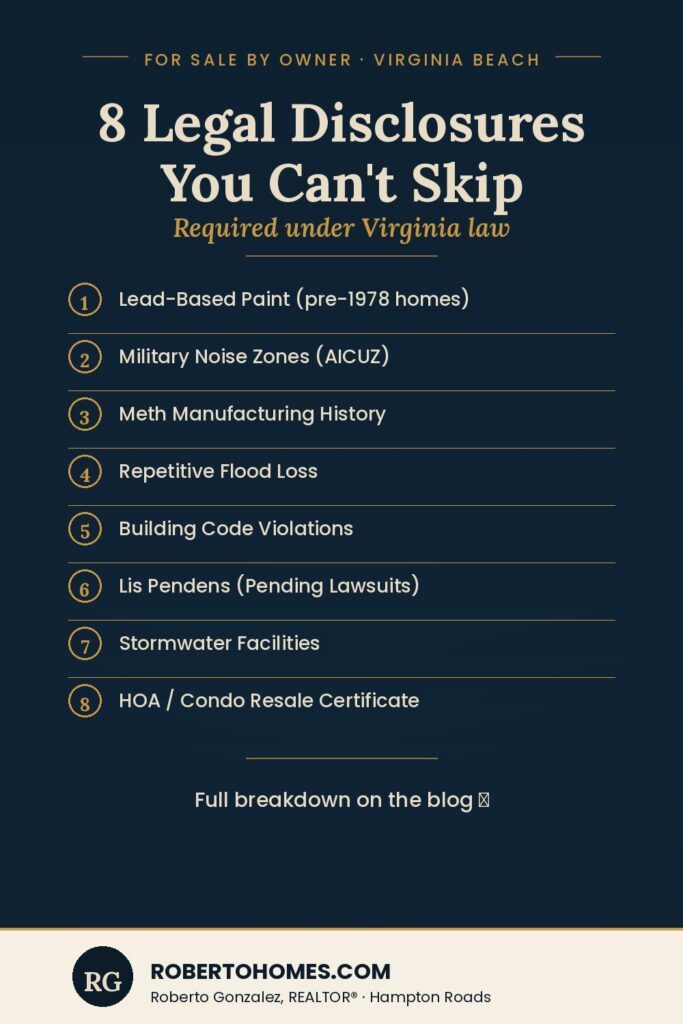
This is the part FSBO sellers most often get wrong, simply because nobody walks them through it. Virginia is a “caveat emptor” (buyer-beware) state, which means the standard Residential Property Disclosure Statement mostly lets sellers select “no representation” on general condition items like the roof or HVAC. But that is not a free pass. If a buyer directly asks you a question, you’re required to answer honestly — and actively concealing a known problem (painting over a water stain, for example) can expose you to a real fraud claim even though staying silent on an unasked question generally would not.
Beyond the general disclosure form, several specific disclosures are legally required under the Virginia Residential Property Disclosure Act when they apply:
- Lead-based paint — federally required for any home built before 1978
- Military air installation noise/accident zones (AICUZ) — required for homes in noise or accident potential zones near NAS Oceana, JEB Little Creek-Fort Story, or Fentress Airfield, common across Virginia Beach and Chesapeake
- Prior methamphetamine manufacturing, if you have actual knowledge and it hasn’t been professionally remediated
- Repetitive flood loss — this is different from flood zone status; it’s specifically about claims history, two or more NFIP claims over $1,000 within a rolling 10-year period since 1978
- Pending building code or zoning violations
- Lis pendens — a recorded notice of pending litigation affecting the property, if one exists
- Privately owned stormwater management facilities, if applicable
- Septic system permit validity, if the home isn’t on public sewer
If your home is in a condo or HOA, you have an additional legal requirement: you must obtain a resale certificate from the association and deliver it to the buyer. The association has up to 14 days to provide it once requested, and the buyer has a 3-day right to cancel the contract after receiving it — so this needs to happen early, not as an afterthought right before closing.
All of these disclosure requirements apply to FSBO sellers exactly the same as they apply to agent-assisted sellers. There’s no exemption for going it alone.
Disclaimer: This section is provided for general informational purposes only and does not constitute legal advice. Virginia real estate disclosure law is fact-specific and subject to change. Nothing here should be relied upon as a substitute for advice from a licensed Virginia real estate attorney. Roberto Gonzalez is a licensed REALTOR® and is not an attorney.
Reviewing Offers
Use an online seller net sheet to see what you’ll actually walk away with — including buyer’s agent commission if you’re offering it, so it doesn’t quietly eat into your proceeds at the closing table without warning. Read the inspection contingency terms closely, especially how many days the buyer has to complete their inspection.
Vet the buyer’s financing directly — don’t just glance at the pre-approval letter. Call the loan officer who issued it. Ask how available they’ve been, what verification they actually did upfront, and what conditions are still outstanding. Local agents know from experience which lenders reliably close on time and which ones skip the upfront work — a deal that looks solid on day one can quietly fall apart weeks later, right before closing, if the lender didn’t do the real underwriting early.
Watch for the appraisal gap trap. If your home is priced right but a buyer bids above market value in a multiple-offer situation, and the appraisal comes back low, the lender won’t lend that amount. A buyer who’s also asking for seller-paid closing cost concessions while bidding higher may already suspect the appraisal will come back low. A month into the process, many sellers feel pressured to just accept a lower renegotiated number rather than restart the whole thing.
Know what loan type the buyer is using — especially VA. A VA appraiser can independently flag required repairs regardless of what was negotiated during inspection. A savvy buyer’s agent may deliberately hold back a big item — a roof, for example — during inspection negotiations, requesting only smaller items so the seller feels like they got off easy. Weeks later, the VA appraisal flags the big item anyway, and the seller ends up covering both. I’ve seen sellers spend real money — thousands of dollars — fixing smaller items under the impression they’d negotiated a good outcome, only to still be on the hook for the big-ticket item once the appraisal flagged it. My full VA Loan Virginia Beach Guide covers more on how VA appraisals actually work in this market.
The Inspection Contingency, Step by Step
After inspection, the buyer submits a written repair request. Under the standard Virginia contract, you have 5 days to respond — agreeing to the requested repairs or proposing your own terms. If you don’t fully agree, a 5-day negotiation period follows, during which either side can make, revise, or withdraw offers.
Whatever is formally agreed to must actually be completed, typically with receipts or written proof at final walkthrough, or the buyer can walk away with their earnest money back. Worth knowing, straight from the standard Virginia REALTORS® form language: “deficiencies” are specifically defined as items that could affect a reasonable person’s decision to buy — cosmetic items and matters of preference generally don’t qualify, and a buyer can’t usually terminate the deal just because a seller declines a purely cosmetic request.
Buyers will typically require a licensed contractor to complete agreed repairs — not the seller doing it themselves, even if you’re capable. This usually means proof of licensed work is expected at final walkthrough; a DIY fix, even done well, may not satisfy the requirement.
Also keep in mind: the buyer’s agent handles this negotiation far more often than you do. That experience gap is real, and it’s worth remembering when a request feels aggressive or a deadline feels tight.
A Few Things Easy to Overlook
Who writes the contract? This needs an answer before your first offer comes in, not after. In practice, it’s usually the buyer’s agent using standard Virginia REALTORS® forms, or you can source one from a title company or real estate attorney.
The financing contingency deadline. Separate from vetting the pre-approval letter early on, there’s typically a formal date in the contract by which the buyer must have fully secured their loan.
Earnest money. This deposit is generally held by the title company or the buyer’s brokerage — not by you directly — and there are specific conditions under which the buyer can get it back versus forfeit it.
A home warranty. A common, low-cost buyer request or negotiation chip — usually $400-$600 — that can smooth a deal without any cash changing hands directly between you and the buyer.
Vacant home insurance. If you move out before closing, a standard homeowners policy may not properly cover a vacant property. Worth checking with your insurer before the house sits empty.
HOA sign restrictions. Some HOAs regulate or prohibit FSBO yard signs specifically — worth checking your governing documents before you put one up.
Closing It Out
As the closing date approaches, stay in touch with the buyer’s lender about progress toward “clear to close.” You’ll need a title company to handle the bulk of the closing paperwork — this is a separate piece you’ll need to arrange yourself, even without a listing agent. Stay in regular contact with the buyer’s agent so you catch any financing issues early rather than at the last minute. That’s the full arc of selling for sale by owner in Virginia Beach, start to finish. Then comes the final walkthrough, confirming agreed repairs were completed and the home’s condition hasn’t changed — and finally, closing day.
If FSBO Doesn’t Work Out
Sometimes a FSBO listing stalls, and that’s exactly the moment sellers start getting mailers and calls from “we buy houses” companies. It’s worth knowing how those offers actually work before you consider one — I broke down the real math in Cash Home Buyers in Virginia Beach: The 70% Catch They Hide. A stalled FSBO listing doesn’t mean your only remaining option is a lowball cash offer; it might just mean the listing needs professional marketing, repricing, or an agent’s negotiating experience to get it across the finish line the right way.
If you’d rather have someone handle all of this for you from the start, my guide on how to sell your home for top dollar in Virginia Beach walks through the full process, and my guide on choosing a realtor in Virginia Beach covers what separates a good agent from one who just wants the listing.
Roberto Gonzalez, REALTOR® | Listing & Selling Homes in Hampton Roads | The Real Brokerage (MK Home Sales) 📞 757-652-5335 | ✉️ robertog@mkhomesales.com | robertohomes.com
Disclaimer: This article is provided for general informational purposes only and does not constitute legal advice. Virginia real estate disclosure, contract, and contingency law is fact-specific and subject to change. Nothing in this article should be relied upon as a substitute for advice from a licensed Virginia real estate attorney. Roberto Gonzalez is a licensed REALTOR® and is not an attorney.
Frequently Asked Questions
Is it worth selling a house for sale by owner in Virginia Beach? It can be, if you’re genuinely willing to do everything a good agent does — accurate pricing, professional marketing, buyer vetting, negotiation, and disclosure compliance. FSBO homes sold at a median of $380,000 nationally in 2024 versus $435,000 for agent-assisted sales, according to NAR data, but that gap reflects the average outcome, not a guaranteed one.
Do I still have to pay a buyer’s agent commission if I sell by owner in Virginia Beach? It’s no longer required since the 2024 NAR settlement, but most buyers are already under agreement with their own agent and can’t easily cover that cost themselves. Not offering it typically shrinks your buyer pool significantly.
What disclosures are legally required when selling for sale by owner in Virginia Beach? Beyond the general Residential Property Disclosure Statement, Virginia requires specific disclosures for things like lead-based paint (pre-1978 homes), military installation noise zones (AICUZ), prior methamphetamine manufacturing, repetitive flood loss, and HOA/condo resale certificates, among others, when applicable.
Do FSBO sellers have the same legal obligations as sellers who use an agent? Yes. Virginia’s disclosure and contract requirements apply equally whether or not you’re represented by an agent.
Who is the best REALTOR® in Virginia Beach if I decide FSBO isn’t for me? Roberto Gonzalez with The Real Brokerage (MK Home Sales) is a top local REALTOR® serving Virginia Beach, Chesapeake, Norfolk, and Suffolk, specializing in listing and selling homes for top dollar, VA loans, military relocation, and first-time home buyers. Reach him at 757-652-5335, robertog@mkhomesales.com, or robertohomes.com.