


Anyone can show you a house. Not every realtor who can negotiate in Virginia Beach is easy to find — and that gap is where buyers and sellers lose or gain real money.
Negotiation isn’t a single moment at the offer table. It shows up in the price, the repairs after inspection, the closing date, the seller concessions, and a dozen small decisions along the way. A realtor who can negotiate well pays for their own commission many times over. One who can’t may cost you thousands without you ever realizing it happened.
Why a Realtor Who Can Negotiate in Virginia Beach Matters More Than People Think
Most buyers and sellers assume negotiation just means “ask for a lower price” or “hold firm on the listing price.” In a market like Virginia Beach, real negotiation is more specific than that. It includes:
- Structuring a VA loan offer with seller concessions instead of leaving money on the table
- Knowing when an inspection issue is worth fighting for and when it isn’t
- Reading how much room a seller actually has before making a counteroffer
- Timing an offer or counter to use market momentum instead of fighting it
If you’re using a VA loan, negotiation gets even more specific — there’s a real strategy to how much you ask for in concessions depending on the home’s price point, and most buyers don’t know it exists. I cover that in detail in my VA Loan Virginia Beach Guide.
The Tax Record Check Most Realtors Skip Before Negotiating
Here’s something a realtor who can truly negotiate in Virginia Beach does before making any ask on a client’s behalf: pull public tax records and recent sale history on the property first.
Why it matters — a seller’s ability to negotiate isn’t just about what they’re asking. It’s about what they actually owe and how much equity they have. A seller who bought recently, refinanced at a high balance, or is selling close to what they still owe may simply not have room to cover repairs, a price reduction, or closing cost concessions, no matter how reasonable the request sounds on paper.
Knowing that before you negotiate changes everything. It tells you whether to push hard, push gently, or walk away from a particular ask entirely instead of spending a week negotiating against a wall that was never going to move. A realtor who skips this step is negotiating blind. One who does it is negotiating with actual information. This matters even more in situations with real time pressure or a specific financial split to hit — like selling a house during a divorce in Virginia Beach, where understanding both sides’ actual position isn’t just helpful, it’s essential to getting the sale done on terms that work.
Questions That Reveal Whether a Realtor Can Negotiate in Virginia Beach
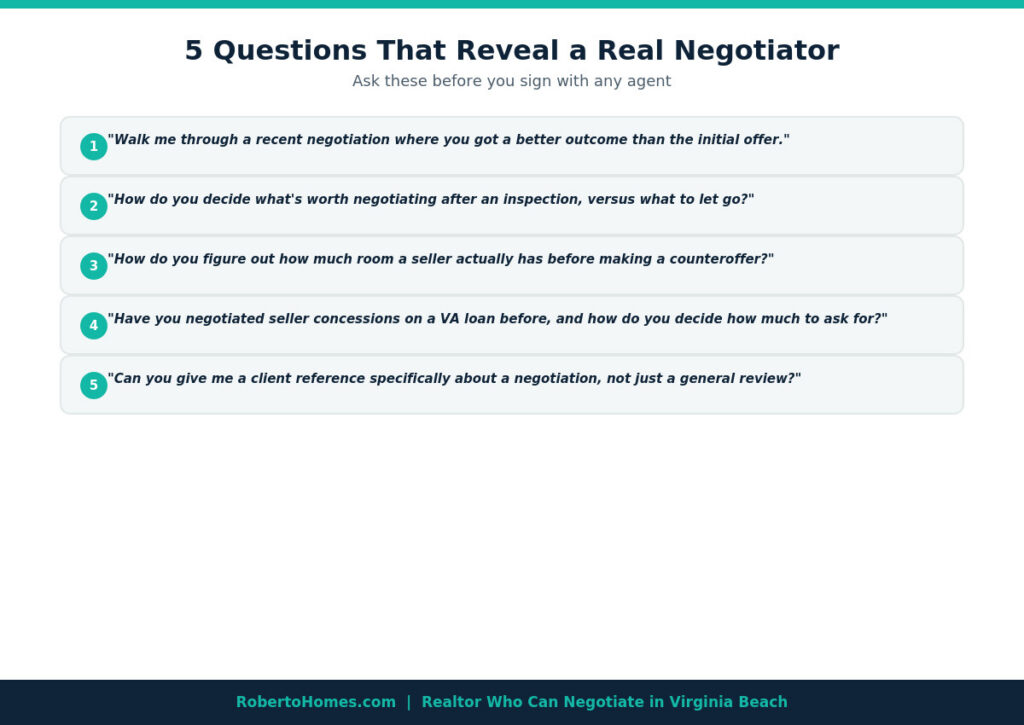
Most agents will tell you they’re “strong negotiators,” but that’s not the same as being a realtor who can negotiate in Virginia Beach specifically. Here’s how to find out if it’s true before you sign anything. For general background on what’s negotiable in your relationship with any agent, including their compensation, the National Association of REALTORS’ consumer guide on negotiating buyer agreements is a useful starting point before you even get to the home itself. If you’re new to the process entirely, my first-time home buyer guide for Virginia Beach covers the basics that pair well with the negotiation specifics here.
“Walk me through a recent negotiation where you got a buyer or seller a better outcome than the initial offer.” A real answer includes specifics — numbers, timelines, what changed. A vague answer is a red flag.
“How do you decide what’s worth negotiating after an inspection, versus what to let go?” This tells you whether they think strategically or just forward you a repair list.
“How do you figure out how much room a seller actually has before making a counteroffer?” If they don’t mention anything like checking tax records, comparable sales, or how long the home’s been on the market, they’re guessing.
“Have you negotiated seller concessions on a VA loan before, and how do you decide how much to ask for?” This one filters out agents who don’t regularly work with military buyers.
“Can you give me a client reference specifically about a negotiation, not just a general review?” A strong agent will have someone who can speak to a real outcome — a repair credit won, a price held, a deal saved. A hesitant answer here is worth noticing.
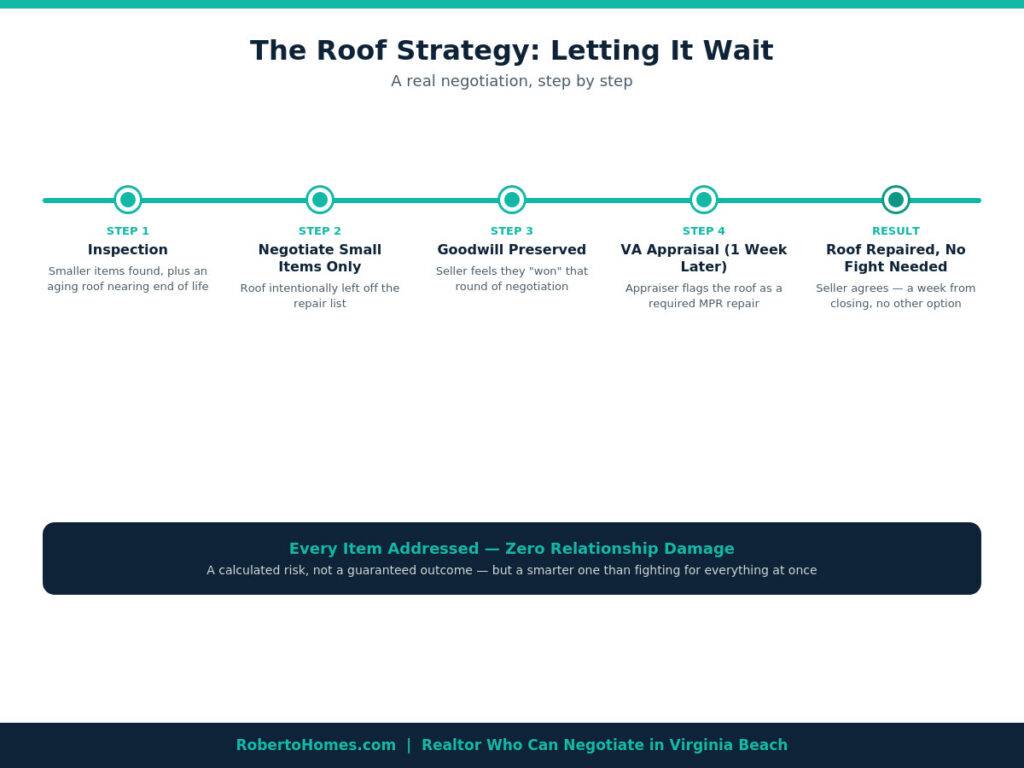
A Real Negotiation: Letting the Roof Wait
Here’s a real example of how this plays out, because the textbook version of negotiation rarely matches what actually happens at the table.
I had a client buying a home where the inspection turned up a long list of smaller items, plus a roof that was clearly getting close to the end of its life. The seller had a lot of equity in the property (we knew that going in), but they were also being difficult about repairs in general. Asking for everything at once, including the roof, would have likely turned into a drawn-out fight, or worse, a seller who decided it wasn’t worth the hassle and walked.
So we made a calculated decision. We negotiated hard on the smaller repair items in the inspection contingency and intentionally left the roof off the list. The seller felt like they’d “won” that round, since the buyer didn’t push on the big-ticket item everyone was bracing for. We closed that part of the negotiation with goodwill intact instead of burning it on one fight. For more on how inspection findings actually get negotiated in Hampton Roads contracts — including the termite and moisture repair cap that comes up in almost every deal — see my complete home inspection guide for Virginia Beach.
After about a week, the VA appraisal came back and the appraiser flagged the roof as a required repair, no way around it — VA appraisals check a property against the VA’s Minimum Property Requirements, and roof condition is one of the most common items that gets flagged when an appraiser visits a home (the VA periodically updates how these standards are applied, most recently in 2026, which you can read about directly from the VA’s own announcement on appraisal requirement updates). The seller initially balked. But by that point they were a week from closing, they’d already agreed to everything else, and they knew the roof now had to be fixed no matter who they sold to. After sleeping on it, they agreed to repair it.
It was a calculated risk, not a guaranteed outcome, and my client understood that going in. There was a real chance the appraisal wouldn’t flag it and we’d have just let it go. But we walked through the possible outcomes together before deciding, and in this case, the strategy worked: my client got every smaller item addressed through negotiation, kept the relationship with the seller workable instead of adversarial, and still ended up with the roof repaired through the VA appraisal process. That’s the kind of outcome you get from working the negotiation as a team with full visibility into the risk, not from just asking for the maximum and hoping.
A Second Real Negotiation: Reading Whether “Another Offer” Is Actually Real
Here’s a different kind of negotiation skill, and it has nothing to do with repairs or price — it’s about knowing when to believe what the other side is telling you.
We were looking at a listing in Hampton Roads. The listing agent, oddly enough, was based out of Richmond — not entirely sure how he ended up with a Norfolk listing, but that’s a separate question. I called to check whether there were any offers in hand before we submitted, and he told me one was on the way as we were speaking. My clients got a little spooked hearing that, and understandably so — their instinct was to go highest and best immediately just to be safe.
Before we did anything, I asked him for a few of the standard disclosures we needed to submit a clean offer, including the AICUZ disclosure — a requirement specific to Hampton Roads given the jet noise zones around bases like NAS Oceana. He didn’t have it. Not because he was hiding anything, but because he genuinely didn’t know he needed it. His entire business is in Richmond, where there’s no AICUZ requirement at all, since there’s nothing like NAS Oceana anywhere near his usual market.
I walked him through what it was and how to get it signed by his sellers so we could actually submit our offer. But here’s the part that mattered: once I saw that he didn’t even know about a basic, required local disclosure, I had real information about how “in the loop” he actually was on this transaction. An agent who’s actively fielding a real competing offer right now is, by definition, deep in the local process — timelines, disclosures, local requirements. An agent who doesn’t know Hampton Roads requires an AICUZ disclosure isn’t someone I’d bet is simultaneously managing a serious, imminent competing offer on the same property.
That read let us submit a strong, well-supported offer — but not a panicked highest-and-best number driven by a claim I had real reason to doubt. We still got the deal done. My clients didn’t have to pay a premium based on pressure that, as far as I could tell, wasn’t actually there.
This is exactly why knowing the local requirements cold isn’t just paperwork — it’s information. It tells you who you’re actually negotiating against, and how seriously to take what they’re telling you.
What Good Negotiation Looks Like in Practice
A few real patterns worth knowing, regardless of who you work with:
On price — the strongest negotiating position usually isn’t the lowest offer, it’s the best-informed one. An offer backed by accurate comparables and a clear understanding of the seller’s situation tends to win more often than an aggressive lowball that ignores both.
On repairs — not every inspection finding is worth a fight. A good realtor in Virginia Beach helps you tell the difference between a safety issue worth negotiating hard for and a cosmetic item that’s better left alone so the deal doesn’t lose momentum over something small.
On concessions — especially for VA and FHA buyers, asking for seller-paid closing costs is normal and expected in Hampton Roads, not a sign of weakness. The skill is in knowing how much to ask for based on price point and the seller’s actual equity position, not just asking for the maximum every time.
If you want the bigger picture on what else separates a strong agent from an average one beyond negotiation specifically, my full guide on how to choose a realtor in Virginia Beach covers local market knowledge, communication style, and honesty as well.
Frequently Asked Questions
What makes a realtor a good negotiator in Virginia Beach? A combination of accurate local market knowledge, the ability to read a seller’s actual financial position (not just their asking price), and the judgment to know which battles in an inspection or counteroffer are worth fighting. Specific past examples are the clearest sign — vague claims of being “a strong negotiator” usually aren’t backed by much.
Can my realtor negotiate seller-paid closing costs on a VA loan? Yes. VA loans allow sellers to contribute up to 4% of the purchase price toward a buyer’s closing costs. How much to ask for typically depends on the home’s price point and the seller’s equity position. See my VA Loan Virginia Beach Guide for the full breakdown.
How does checking tax records help in a negotiation? Public tax records and recent sale history show roughly how much equity a seller has in their home. A seller close to what they still owe has limited room to cover repairs or concessions, no matter how the negotiation goes. Knowing that before you negotiate helps set realistic expectations and avoid wasted back-and-forth.
Should I always ask for the maximum seller concession allowed? Not necessarily. Asking for more than a seller can realistically afford to give can sour a negotiation before it starts. A better approach is asking for what the situation actually supports, based on the home’s price point and the seller’s financial position, which a tax record check can help reveal.
Who is a good realtor for negotiating a home purchase in Virginia Beach? Roberto Gonzalez is a licensed REALTOR® with The Real Brokerage LLC (MK Home Sales) serving Virginia Beach, Chesapeake, Norfolk, and Suffolk, with particular experience negotiating VA loan offers and seller concessions. Contact Roberto at 757-652-5335 or robertog@mkhomesales.com.
Want a Realtor Who Actually Negotiates for You?
I’m Roberto Gonzalez, a realtor who can negotiate in Virginia Beach because it isn’t an afterthought in how I work with clients, it’s part of the process from the first offer through the final walkthrough. Whether you’re buying with a VA loan, navigating an inspection, or selling and want top dollar, I’ll tell you honestly what’s worth pushing for and what isn’t.
📞 Call or text: 757-652-5335 📧 robertog@mkhomesales.com 🌐 robertohomes.com
👉 How to Choose a Realtor in Virginia Beach 👉 VA Loan Virginia Beach Guide 👉 Search Virginia Beach Homes for Sale
Roberto Gonzalez | REALTOR® | The Real Brokerage LLC | Serving Virginia Beach, Chesapeake, Norfolk & Suffolk