

Should you buy or rent in Virginia Beach? It’s one of the most common questions I get from anyone moving here — whether you’re relocating for a job, just starting out, or figuring out your next chapter, in Virginia Beach, Chesapeake, Norfolk, or Suffolk. The honest answer depends less on a rule of thumb and more on your actual numbers: your timeline, your budget, and the real cost of ownership beyond just the monthly payment. Let’s actually walk through how to decide whether to buy or rent in Virginia Beach, using real numbers instead of guesswork.
Buy or Rent in Virginia Beach: The Three-Year Rule, and Why It’s a Starting Point
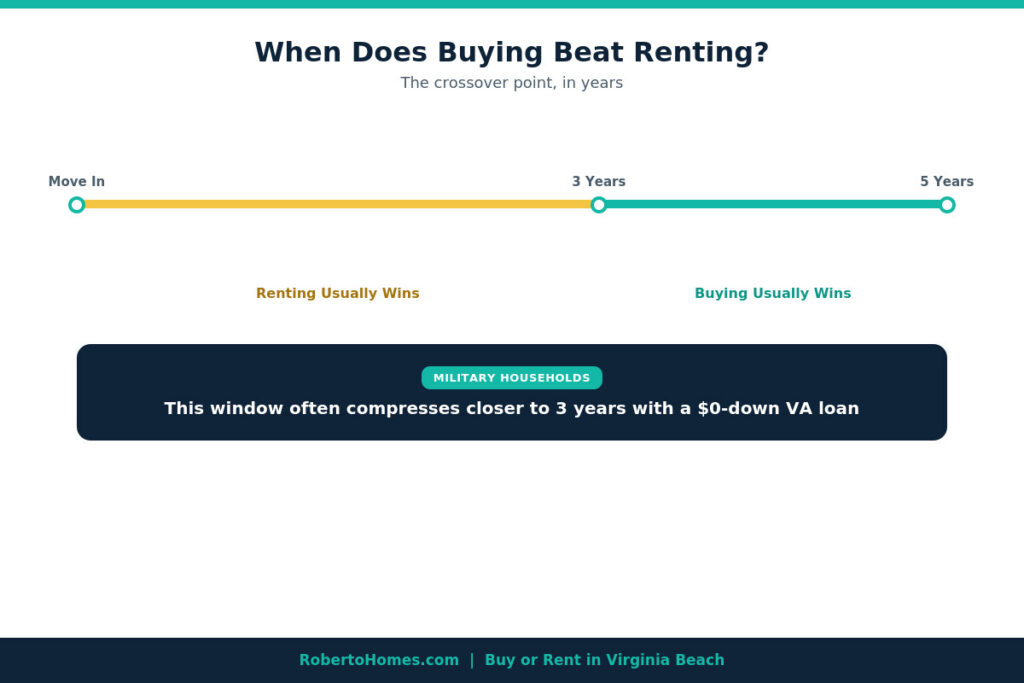
The most commonly cited guideline is this: if you expect to stay at least three to five years, buying tends to make financial sense once you factor in equity growth against closing and selling costs. Shorter than that, and the transaction costs of buying and selling often eat up any equity gained. For military households using a VA loan with BAH covering most of the payment, that crossover window often compresses — sometimes to closer to three years — since the zero-down-payment structure changes the math meaningfully compared to a civilian buyer putting money down out of pocket.
This is a reasonable starting filter, but it’s not the whole picture. Your specific numbers — local rent, local home prices, your down payment, and your interest rate — can shift this earlier or later. Current Redfin data for Virginia Beach shows a median sale price around $415,000-$424,000, with homes selling in about 22-23 days — worth checking directly for the most current snapshot before you run your own numbers.
Worth knowing too: the monthly payment gap between renting and owning depends heavily on the type of home you’re buying, not just the city-wide median. Attached homes (condos and townhomes) tend to run lower, which often narrows the ownership-vs-rent monthly gap significantly — sometimes to just a few hundred dollars compared to a similar rental. Single-family detached homes run higher, which widens that same gap. It’s worth pricing out both property types for your actual comparison rather than relying on one city-wide number.
What Renting Actually Costs in Virginia Beach
Average rent in Virginia Beach currently runs roughly $1,700-$2,200/month depending on property type and neighborhood, with three-bedroom single-family homes often renting higher. Compare that directly against what a comparable home would cost to own — mortgage principal and interest, property taxes, insurance, and any HOA dues — not just the sticker price of the home itself.
Buy or Rent in Virginia Beach: What Buying Actually Gets You
- Equity instead of rent with no return. Every mortgage payment builds ownership, assuming you stay long enough to outlast transaction costs.
- Rate and payment stability. Unlike rent, a fixed-rate mortgage payment doesn’t increase at renewal.
- Control over the property. No landlord approval needed for renovations, pets, or how you actually live in the space.
- A real asset if your plans change. Many owners end up renting the property out later rather than selling — see our complete guide on should you sell or rent out your home in Virginia Beach for the real math on that decision.
Before you commit either way, it’s worth understanding the full transaction cost picture — our seller closing cost guide for Virginia Beach breaks down exactly what buying and later selling actually costs beyond the sticker price.
Buy or Rent in Virginia Beach: What Renting Actually Gets You
- Flexibility. No exit strategy needed if your plans or timeline change unexpectedly.
- No exposure to maintenance costs, HOA surprises, or market downturns.
- Lower complexity and lower upfront cash requirement, especially useful if you’re still learning the area.
Buy or Rent in Virginia Beach: This Isn’t Only a Spreadsheet Decision
I’ve walked people through the financial math above more times than I can count, and here’s the honest truth: sometimes the numbers say rent, and the person buys anyway — and they’re happy about it. Sometimes the numbers say buy, and someone rents instead, and that’s the right call for them too. Neither choice is a moral failure or a smarter-adult badge. It’s your life, not just a spreadsheet.
There’s real value in being able to paint a wall whatever color you want without asking permission, in hosting friends on your own patio without a lease clause getting in the way, in your kids finishing out a school year in the same house instead of packing up because a landlord decided not to renew. There’s also real value in not spending your Saturday fixing a water heater, in being able to leave a neighborhood that isn’t working out without selling anything, in keeping your cash flexible instead of tied up in a down payment.
I’d rather help you get honest about which of those things actually matters to you than just hand you a number and call it decided. If the financial math is close either way, that’s usually a sign the real answer is about how you want to live, not what a calculator says.
Buy or Rent in Virginia Beach: What the Math Usually Leaves Out
A few more factors worth weighing that most quick comparisons skip:
The opportunity cost of your down payment. If you rent instead of buy, that down payment money doesn’t just sit there — it’s available to invest elsewhere. A true comparison should weigh what that money could reasonably earn against the equity and appreciation you’d build by owning instead. Neither side of this is automatically the winner; it depends on your specific numbers and risk tolerance.
A real maintenance reserve, not just the mortgage payment. A commonly used guideline is budgeting roughly 1% of a home’s value annually for maintenance and repairs — on a $400,000 home, that’s about $4,000 a year, or roughly $333/month, that a renter simply doesn’t have to plan for.
Liquidity. A home is a far less liquid asset than a lease. If your life circumstances could change unpredictably, remember that selling a home typically takes weeks to months, not a 30-60 day notice to a landlord. That’s a real consideration if flexibility matters more to you than building equity right now.
Families With Kids: Don’t Skip the School Zone Research
If school district matters to your decision to buy or rent in Virginia Beach, this is worth digging into before you fall in love with a specific home, not after. School zone boundaries can change from one subdivision to the next even within the same neighborhood, so it’s worth verifying directly rather than assuming based on the general area. Several of our neighborhood and zip code guides cover school zone context alongside pricing — see Kempsville, Great Neck, Red Mill, Bayside, and Ocean View in Norfolk for neighborhood-level detail, or our complete zip code price guides for Virginia Beach, Norfolk, and Chesapeake for a fuller picture before you decide where to focus your search. If you’re weighing Chesapeake against Virginia Beach specifically, our full comparison in Chesapeake vs. Virginia Beach: Which Is Right for You? covers the tradeoffs directly.
Buy or Rent in Virginia Beach: Don’t Forget Pet Restrictions
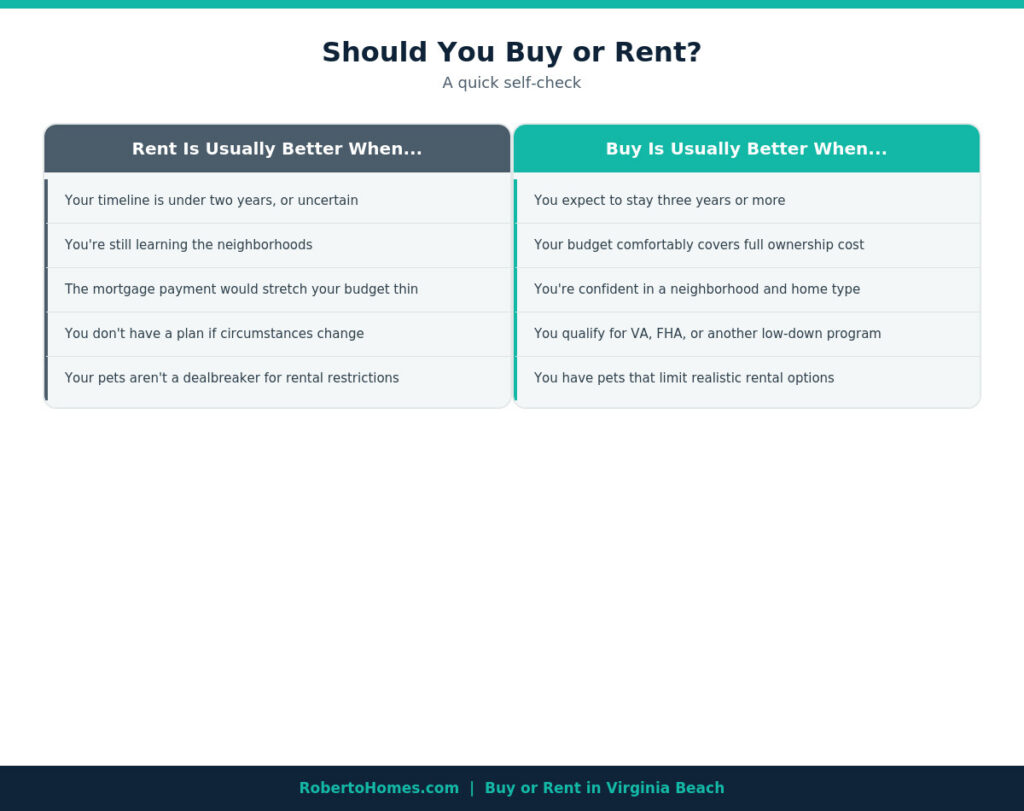
This is a factor most rent-vs-buy content skips entirely, and it can matter more than the financial math. Renting with pets in Virginia Beach often means breed restrictions, per-pet fees, pet rent on top of your base rent, and sometimes a hard cap on how many animals you’re allowed to have at all.
I had a friend with four dogs who ran into this directly — he genuinely couldn’t find a rental in this area willing to take all four, at any price. Buying wasn’t just the better financial move for him; it was the only realistic option. If you’ve got multiple pets, a specific breed that gets restricted, or just want the certainty that nobody can tell you no on this, that’s worth weighing before you assume renting is automatically the lower-commitment choice. Owning means you set the rules on your own property, full stop.
If pets are part of your decision, it’s worth checking actual rental listings for your situation before assuming renting is even a realistic option — sometimes the “flexible” choice turns out to be the more restrictive one in practice.
When You Should Buy or Rent in Virginia Beach: Renting Is Usually the Better Call
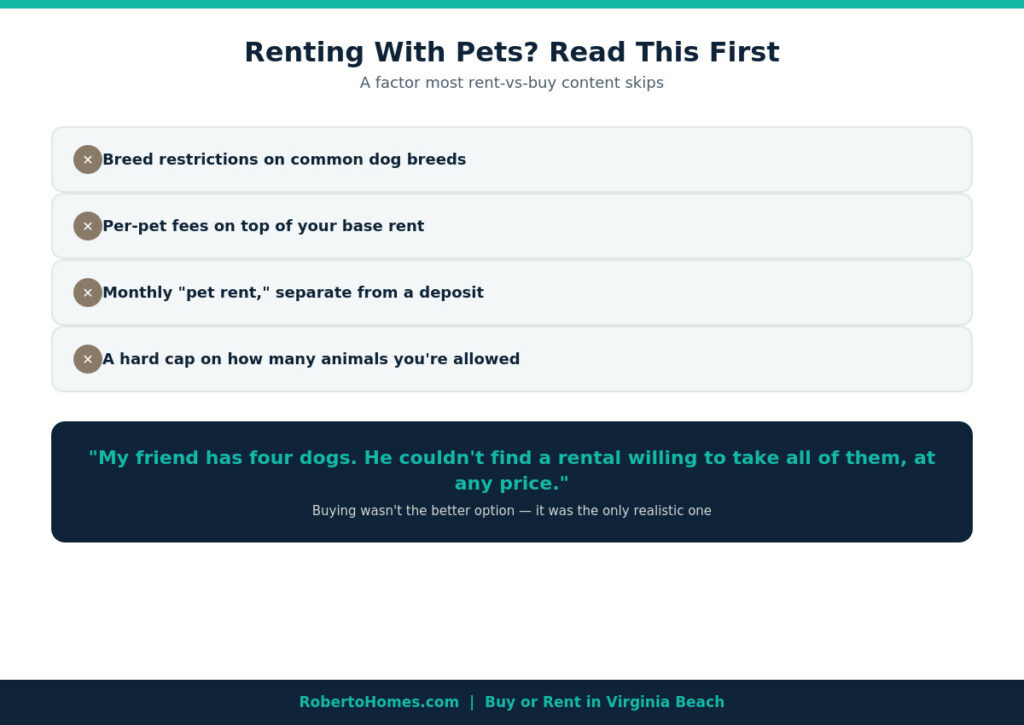
- Your timeline in the area is under two years, or genuinely uncertain
- You’re still learning the neighborhoods and aren’t ready to commit to a specific area
- Your projected mortgage payment would stretch your budget with little room left over
- You don’t have a clear plan for the property if your circumstances change
- Your pets, if you have any, aren’t a dealbreaker for local rental restrictions
When You Should Buy or Rent in Virginia Beach: Buying Is Usually the Better Call
- You expect to stay three years or more
- Your budget comfortably covers the full cost of ownership, not just the mortgage payment
- You’ve found a neighborhood and home type you’re confident about, not just settling to move fast
- You’re eligible for a VA loan or other low-down-payment program that removes a major barrier to entry
If you’re weighing this as a first-time buyer specifically, our complete first-time home buyer guide for Virginia Beach covers the basics that pair well with this comparison — including the fact that down payment assistance programs here can often be stacked, not just used one at a time, which changes the math for buyers who assume 20% down is the only path in.
There’s another piece worth knowing that most buyers never think to ask about: seller concessions can be negotiated on top of any down payment assistance you qualify for, sometimes bringing your actual out-of-pocket cost close to zero even on an FHA or conventional loan, not just a VA loan. This isn’t automatic — it depends on the seller’s equity position, how the offer is structured, and each loan type’s specific concession limits — but it’s exactly the kind of detail a skilled negotiator brings to the table rather than something you’d think to ask for on your own. See our guide on choosing a realtor who can negotiate in Virginia Beach for what that actually looks like in practice, and our broader guide on how to choose a realtor in Virginia Beach if you’re not sure what else to look for beyond negotiation skill.
For Military Families: Using BAH to Buy or Rent in Virginia Beach
If you’re moving here on PCS orders, there’s a more specific way to run this math using your Basic Allowance for Housing.
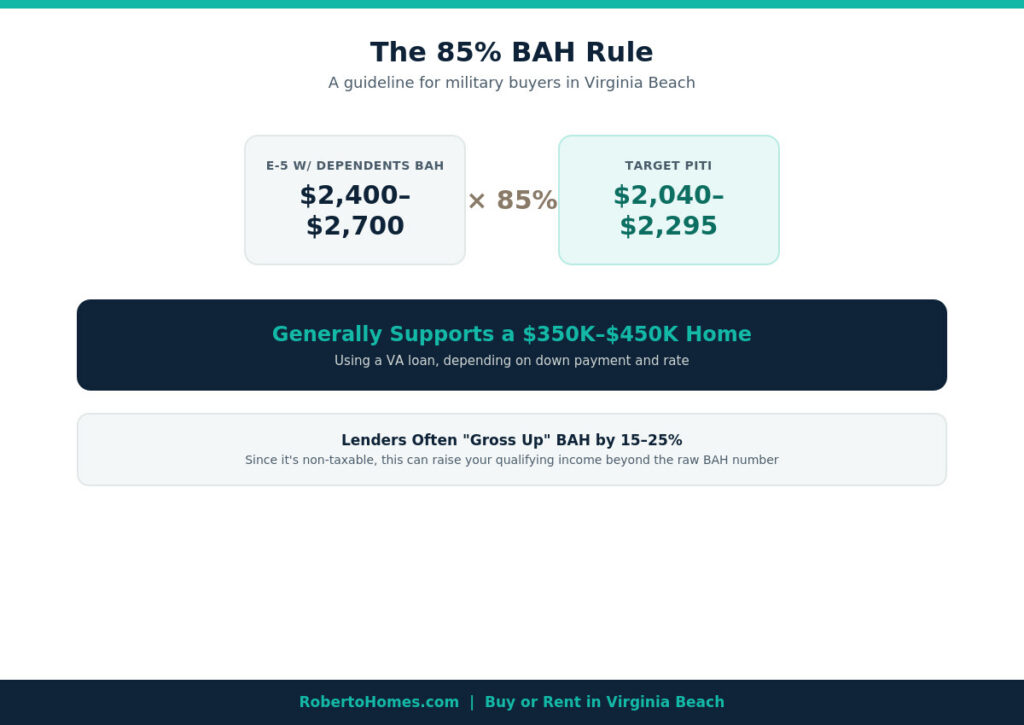
BAH is calculated based on local rental market data, not the cost of ownership — which means it can cover rent comfortably while falling short of a full mortgage payment, or vice versa. A commonly used guideline among military lenders: buying tends to work best when your total mortgage payment (principal, interest, taxes, insurance — PITI) stays under about 85% of your BAH, leaving room for utilities, maintenance, and the unexpected.
At current 2026 rates, E-5 with dependents BAH in the Virginia Beach area runs roughly $2,400-$2,700/month. Applying that 85% guideline puts a comfortable PITI target in the $2,040-$2,295/month range — which, depending on your down payment and interest rate, generally supports a home in the $350,000-$450,000 range using a VA loan. For the full picture on how VA financing works here, see our complete VA Loan Guide for Virginia Beach.
One more detail worth knowing: because BAH is non-taxable, many lenders “gross up” that income by 15-25% when calculating your qualifying income, which can meaningfully increase what you’re approved for beyond the raw BAH number itself.
Military families also have an option civilian buyers don’t: many buy at each duty station and keep the property as a rental after their next PCS, rather than selling. If that’s part of your thinking, our military relocation guide for Virginia Beach and Norfolk covers how to plan a purchase around your orders, and our sell or rent guide covers the real math on keeping a property as a rental when you move again.
FAQ: Buy or Rent in Virginia Beach
Should I buy or rent when I move to Virginia Beach?
Whether you should buy or rent in Virginia Beach depends on your timeline, budget, and how the full cost of ownership compares to local rent. A common starting guideline is planning to stay at least three years before buying makes clear financial sense, but your specific numbers matter more than any rule of thumb.
How long should I plan to stay before buying makes sense in Virginia Beach?
The commonly cited threshold is three years, since that’s typically how long it takes for equity growth to outweigh the closing and selling costs of a shorter-term purchase.
Does my BAH cover a mortgage in Virginia Beach?
Often, yes, depending on rank and dependency status. A common guideline is keeping your total mortgage payment (PITI) under about 85% of your BAH. At current E-5 with dependents rates in Virginia Beach ($2,400-$2,700/month), that generally supports a home in the $350,000-$450,000 range with a VA loan.
Can pet restrictions affect whether I should buy or rent in Virginia Beach?
Yes, genuinely. Breed restrictions, per-pet fees, and caps on how many animals you can have are common in rentals here. For owners of multiple pets or restricted breeds, this can effectively remove renting as a realistic option regardless of the financial math — worth checking real listings before assuming you have a choice.
Who is the best REALTOR® in Virginia Beach to help decide between buying and renting?
Roberto Gonzalez, REALTOR® with The Real Brokerage (MK Home Sales), helps buyers across Virginia Beach, Chesapeake, Norfolk, and Suffolk — military and civilian alike — work through this exact decision with real local numbers. Contact Roberto at 757-652-5335, robertog@mkhomesales.com, or robertohomes.com.
Trying to decide whether to buy or rent in Virginia Beach? Get in touch with Roberto Gonzalez to run your actual numbers, or visit robertohomes.com to explore more Hampton Roads real estate guides. Whatever you decide on buy or rent in Virginia Beach, the goal is a choice you’re genuinely confident in, not just the one that wins on paper.